
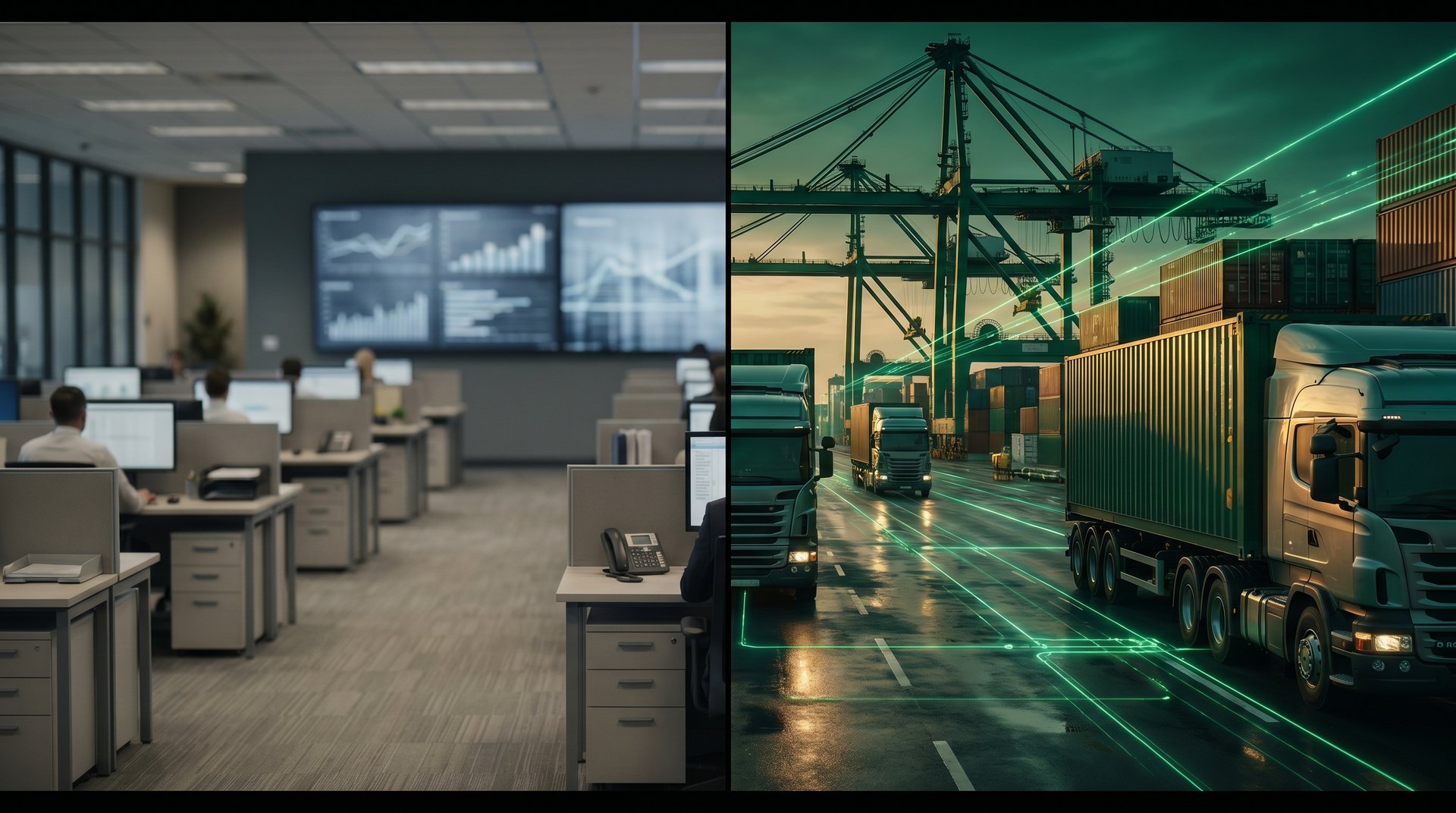
For companies running logistics, transport, or foreign-trade operations, a logistics-specific (vertical) ERP usually delivers value faster than a general-purpose ERP. General ERPs cover industry-agnostic processes such as accounting, manufacturing, and inventory, but they can only add freight/dispatch management, CMR, container-booking-freight, and fleet processes through expensive customization. In a vertical logistics ERP these flows come out-of-the-box. If logistics is your core business, choose a vertical ERP; if it is only a side process, a general ERP plus a TMS module is the better fit.
What is the difference between a general-purpose ERP and a logistics-specific ERP?
A general-purpose ERP is designed to be adapted to any industry: it covers horizontal processes such as accounting, procurement, manufacturing, and general inventory. Their strength is breadth, but the processes that actually run daily logistics operations do not come “ready” in these packages. The position, dispatch, trip and route planning, CMR, sea-side booking-container-port-freight records, or fleet-side fuel-insurance-maintenance-tyre tracking that a transport company needs typically have to be built through customization or third-party add-ons.
A logistics-specific (vertical) ERP, on the other hand, embeds these processes into the product core. The industry’s terminology, regulations (for example Turkey’s GİB e-Invoice/e-Archive), and operational flows are built in as standard. Loggerise sits squarely in this category: an Ankara/Turkey-based, cloud (SaaS), multi-tenant logistics and foreign-trade ERP — not a general ERP, but a sector-specific vertical ERP.
📊 Industry data: According to Forrester’s Total Economic Impact (TEI) studies, enterprise ERP investments deliver a 101% three-year ROI and midmarket organizations reach payback in about 16 months. Choosing the right ERP accelerates that return. Forrester Consulting (2026)
General ERP or logistics ERP? Comparison table
| Criterion | General-Purpose ERP | Logistics-Specific (Vertical) ERP — e.g. Loggerise |
|---|---|---|
| Core focus | Industry-agnostic: accounting, procurement, manufacturing, general inventory | Freight/transport, fleet, sea transport, foreign-trade processes |
| Transport management | Usually requires an add-on/separate module or customization | Built-in: position, dispatch, trip, route planning, CMR |
| Fleet management | Not in standard scope; needs third-party integration | Built-in: vehicle, driver, fuel, insurance, maintenance, tyre |
| Sea transport | Barely present | Built-in: booking, container, port, freight records |
| Warehouse (WMS) | Basic inventory; advanced warehouse needs extra licensing | Built-in warehouse/WMS: stock, location, serial/batch records |
| Finance & local compliance | General accounting; integrator/customization for local e-invoicing | e-Invoice (GİB e-Finans), e-Archive, e-Waybill, CBRT FX rates, bank, cash, cheque/note, FX accounts |
| Time-to-deploy | Long consulting, heavy customization | Industry flows ready out-of-the-box |
| Terminology & usage | Generic business terms | Speaks the language of logistics/foreign trade |
| AI & mobile | Generic; not sector-specific | Loggy AI assistant (natural-language query + reporting), iOS & Android driver app |
| Ecosystem | None | Freight pool / LoggyGo (open freight marketplace, carrier matching) |
| Integrations | Variable; rarely covers logistics services | Logo, Zirve, Uyumsoft, QNB e-Finans, AS24, Seyir Mobil, Naiton (GPS-Buddy), CBRT |
| Delivery model | Mostly on-premise/heavy cloud, high upfront cost | Cloud SaaS, multi-tenant; subscription via Iyzico, 14-day free trial |
Note: This table is a general comparison; every general ERP differs in scope and some may offer vertical logistics modules. Base your decision on the intensity of your own operations.
Why should a logistics company choose a vertical ERP?
The first reason is data integrity. When you spread operations across multiple general modules and add-ons, your trip, fleet, finance, and customs data become fragmented, which complicates reporting and increases the risk of errors. A vertical ERP consolidates logistics data into a single model.
📊 Industry data: According to Gartner research, poor data quality (inaccurate and incomplete data) costs organizations an average of $12.9 million per year. Consolidating processes into a single vertical system helps reduce that loss. Gartner (2021)
The second reason is cost pressure. Margins in road freight are thin and fuel is one of the heaviest cost items; a built-in module that manages fleet and fuel data accurately affects the bottom line directly.
📊 Industry data: According to the IRU, fuel costs make up roughly one third (~30%) of total operating costs in European road freight, while most companies operate on margins of only ~2%. IRU (2026)
Loggerise’s fleet management module brings vehicle, driver, fuel, insurance, maintenance, and tyre tracking together in one place and integrates with telematics services such as AS24 and Naiton (GPS-Buddy). The operational return of such telematics integrations is supported by industry data.
📊 Industry data: According to Verizon Connect’s 2025 report, average fuel savings among fleets using GPS/telematics tracking doubled from 8% in 2021 to 16% in 2025, and 47% of businesses using the technology achieved a positive ROI in under a year. Verizon Connect (2025)
The third reason is local regulatory compliance. In Turkey, e-invoicing is now a widespread obligation; a logistics ERP that provides this natively resolves compliance without turning it into a customization project.
📊 Industry data: According to the Turkish Revenue Administration’s (GİB) 2024 Activity Report, as of 31 December 2024 some 1,486,941 taxpayers were registered for e-Invoice and 1,549,138 for e-Archive Invoice. GİB 2024 Activity Report (2024)
Loggerise’s finance module natively provides e-Invoice (GİB e-Finans), e-Archive, e-Waybill, CBRT FX rates, bank, cash, cheque/note, and FX current-account management, and integrates with accounting solutions such as Logo, Zirve, and Uyumsoft.
When does a general ERP make more sense?
A vertical ERP is not the default answer for every company. If your core business is manufacturing or retail and your transport operation is relatively simple, supplementing your existing general ERP with a TMS (Transport Management System) module may be enough. In that case logistics is an extension of your main processes, and the finance-manufacturing-inventory integration a general ERP offers is more valuable.
Conversely, if the heart of your operation is transport, customs, sea freight, fleet, or foreign trade, the customization and consulting budget you would spend adapting a general ERP to those processes often exceeds the total cost of ownership of a vertical ERP. For these companies, a logistics-specific ERP offers lower TCO and faster deployment.
Which logistics processes does Loggerise cover out-of-the-box?
Loggerise consolidates a logistics company’s end-to-end operation on a single platform:
- Freight/transport management: position, dispatch, trip, route planning, CMR
- Fleet management: vehicle, driver, fuel, insurance, maintenance, tyre
- Finance: e-Invoice (GİB e-Finans), e-Archive, e-Waybill, CBRT FX rates, bank, cash, cheque/note, FX current accounts
- Warehouse/WMS: stock, location, serial/batch records
- Sea transport: booking, container, port, freight records
- CRM and Human Resources
- Loggy AI assistant: natural-language query and reporting
- Driver mobile app: iOS & Android
- Freight pool / LoggyGo: open freight marketplace and carrier matching
These modules are supported by integrations with Logo, Zirve, Uyumsoft, QNB e-Finans, AS24, Seyir Mobil, Naiton (GPS-Buddy), and CBRT. Investment in sector technology is also rising, which accelerates the move to vertical solutions.
📊 Industry data: According to Gartner, 82% of chief supply chain officers (CSCOs) say they will increase their investment in supply chain technology over the next two years. Gartner (2024)
Frequently Asked Questions
I already have a general ERP; why switch to a vertical ERP instead of customizing it for logistics?
Customization means bolting position/trip management, CMR, container-freight, and fleet processes onto a general ERP after the fact, which brings long consulting cycles, ongoing maintenance overhead, and fragile integrations. In a vertical ERP these flows come ready. If most of your operation is logistics/foreign trade, the vertical solution usually offers a lower total cost of ownership.
Exactly which processes does Loggerise cover?
Freight/transport management (position, dispatch, trip, route planning, CMR), fleet management (vehicle, driver, fuel, insurance, maintenance, tyre), finance (e-Invoice/GİB e-Finans, e-Archive, e-Waybill, CBRT FX rates, bank, cash, cheque/note, FX current accounts), warehouse/WMS, sea transport (booking, container, port, freight), CRM, Human Resources, the Loggy AI assistant, an iOS & Android driver app, and the freight pool/LoggyGo.
What advantage does being cloud/SaaS provide?
Loggerise is a cloud, multi-tenant SaaS that works on a subscription model via Iyzico and offers a 14-day free trial. This lets you start without heavy on-premise deployment and high upfront cost, receive updates centrally, and give your team access from anywhere. There is a separate iOS & Android app for drivers.
How is e-invoicing and regulatory compliance in Turkey handled?
The Loggerise finance module natively provides e-Invoice (GİB e-Finans), e-Archive, and e-Waybill, along with CBRT FX rates, FX current accounts, cheque/note, bank, and cash management, supported by integrations such as QNB e-Finans and Uyumsoft. Given how widely e-invoicing is adopted in Turkey, having this compliance built into the ERP saves a separate integration project.
Which companies should choose a vertical logistics ERP?
International transport/logistics companies, customs brokerages, sea-freight/forwarder firms, foreign-trade companies, fleet operators, and distribution firms. If logistics is your core business, choose a vertical ERP; if it is only a side process, a general ERP plus a TMS module can be considered.
Is a vertical ERP more expensive than a general ERP?
License price alone is misleading; what should be compared is total cost of ownership (TCO). In a general ERP, the customization, consulting, and maintenance needed to add logistics processes raise the cost over time. Because industry flows come ready, a vertical ERP usually offers lower TCO and faster go-live for logistics-heavy companies.
Conclusion
If the heart of your operation is transport, fleet, customs, or foreign trade, a sector-specific vertical ERP delivers value faster than a general-purpose ERP. You can try Loggerise free for 14 days to see how your logistics processes come together on a single platform. Explore the Loggerise logistics ERP.