
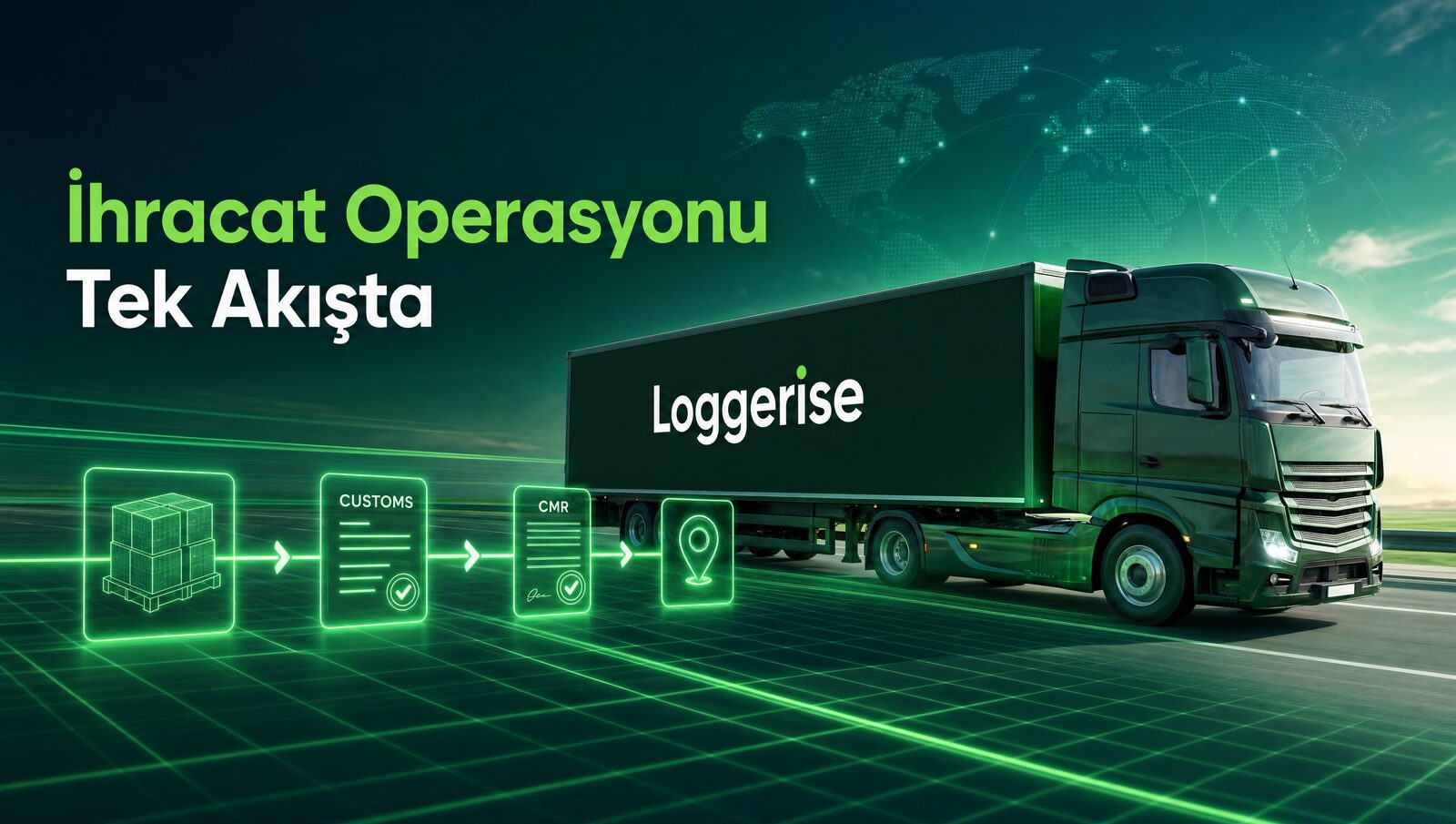
In most companies, export operations live across five separate files: the cargo information is in one place, the customs declaration in another folder, the CMR on a completely different desk, the bonded warehouse record on its own, and the delivery terms buried inside e-mails. When one is updated, the others go stale and no one can be sure which document is the final version. This is exactly why export operations end up far harder and more error-prone than they should be. In this article we cover why export operations fall apart, the 6-step life of an export shipment, and why combining all these steps into a single flow makes a difference.
📊 Industry data: Per the WTO, the Trade Facilitation Agreement can cut average export time by 91%. Dünya Ticaret Örgütü (WTO) – Trade Facilitation
Why are export operations managed in a scattered way?
Export is, by its very nature, a multi-actor and multi-document process. As the shipper, consignee, customs broker, carrier, bonded warehouse, and bank all revolve around the same shipment, each keeps its own paperwork in its own system. Inside the company, too, information is fragmented: operations knows the cargo, accounting issues the invoice, the field carries the CMR. When these pieces don’t talk to each other, export operations never appear as a whole on any single screen. The result is a process that runs on phone calls and e-mails, where people constantly ask “who has the most up-to-date information?”
The 6-step life of an export shipment
A healthy export operation must track the following six steps of the shipment without any breaks:
- Cargo: A cargo record is opened with the customer, goods, quantity, and delivery terms.
- Position: The cargo is linked to a transport position; the route and vehicle plan are finalized.
- Trip: The vehicle and driver are assigned, and the trip actually begins.
- Customs: At this step the CMR, customs declaration, T1/T2, and bonded warehouse records move forward together with the shipment.
- Delivery terms: Delivery terms such as CIF and FOB define the boundary of cost and responsibility.
- Invoice: All this data flows into the invoice; income and expense are fed from the same flow.
When these six steps are kept in separate systems, information is re-entered by hand at every transition, and every manual entry means a new chance of error.
The 3 hidden costs of scattered management
Running export operations in a fragmented way is not only exhausting; it has three concrete costs:
- Stale information: When one file is updated and the others are not, the team makes decisions based on the wrong data.
- Repeated errors: When the same information is entered five times, inconsistency arises in five separate places; a discrepancy appears at customs or on the invoice.
- Blind spots: Which shipment is at which stage isn’t visible at a glance; delays are only noticed when the customer asks.
Export operations in a single flow
The solution is to run these six steps on a single record, without breaks. Loggerise logistics ERP manages the export shipment in a single flow along the cargo → position → trip → customs (CMR, declaration, T1/T2, bonded warehouse, delivery terms) → invoice line. Each step is recorded on the same shipment’s record; an update at one stage instantly updates the others. This way the question “who has the most up-to-date information?” disappears, because a single correct record is in front of everyone.
This integrity brings not only order but also speed: the customs document arrives ready together with the shipment, the invoice is automatically fed from the same data, and the delivery terms reflect the cost correctly. Instead of chasing documents, the operations team manages the work.
Why isn’t a generic fleet program enough?
An ordinary fleet-tracking program tells you where the vehicle is, but it doesn’t recognize the layers of export such as customs, bonded warehouse, and delivery terms. Export operations are far more than the location of the vehicle; they require a logistics ERP to combine the entire chain from customs to invoice into a single set of data. A generic tool cannot offer this depth; that is why the right foundation for an exporter is an ERP built specifically for logistics.
Frequently Asked Questions
Does export operations require a separate program?
General accounting or fleet tracking alone is not enough. You need a logistics ERP that manages the customs and document layers of export in a single flow.
Can the CMR, declaration, and MRN be kept in the same place?
Yes. In the right system these documents are linked to the shipment’s record and move forward together with the trip; they aren’t searched for in separate folders.
Does it also apply to a low-volume exporter?
Yes. Even at low volume, broken documents create cost; for small teams, lightweight solutions such as Loggerise ERP also offer a starting point.
Manage your export operations in a single flow
Combine every step from cargo to invoice into a single flow; stop chasing documents and gain real-time visibility. Explore Loggerise ERP 👉 loggerise.com.