
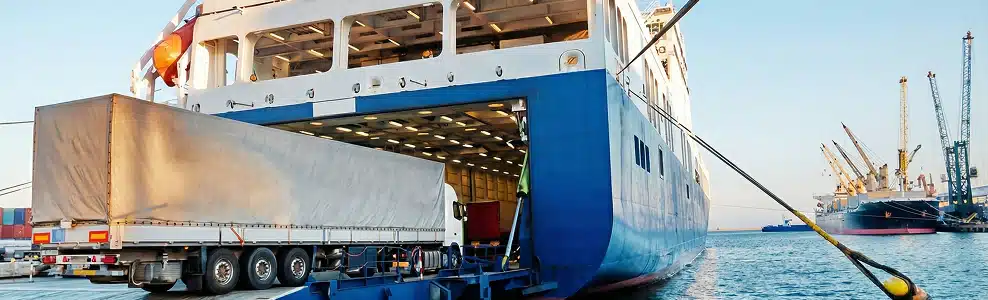
The Turkish logistics sector is the bridge for trade with Europe. Undoubtedly, one of the most critical pillars of this bridge is Ro-Ro (Roll-on/Roll-off) transportation. Vessels departing from ports like Pendik, Yalova, Mersin, or Çeşme carry thousands of trucks to ports such as Trieste, Sète, Toulon, or Bari.
However, from an operational perspective, the Ro-Ro process is often a “Black Box.” A truck is tracked via GPS while on the road, but visibility vanishes the moment it enters the port area. Reservations are made through separate portals, ticket costs are kept in Excel, and the trip plan is managed in different software. This fragmentation leads to vehicles missing the ship (No-Show), incorrect calculation of ticket costs, and an inability to provide instant answers to the customer’s question: “Is my truck on the ship?”
The Loggerise Ro-Ro Tracking and Management Module eliminates this fragmented structure. By merging your road operations and sea crossings into a single Timeline, it offers a truly multimodal management experience.
In this comprehensive guide, we will explore how to integrate Ro-Ro processes into the main trip plan, how to illuminate blind spots in port operations, and how to control foreign currency-based ticket costs.
1. “A Trip Within a Trip”: Multimodal Integration
The biggest mistake in traditional logistics management is treating a Ro-Ro crossing as an external event independent of the main trip. In reality, Ro-Ro is an integral part of the transportation process itself.
Loggerise integrates Ro-Ro processes 100% with the Trip Management module.
Unified Structure
Imagine a truck traveling from Istanbul to Munich. Part of this trip is by road, part is by sea (e.g., Pendik-Trieste), and the rest is by road again. In Loggerise, you don’t fragment this process:
While creating a trip card, simply click the “Add Ro-Ro Crossing” button.
Select from defined lines (e.g., DFDS Pendik – Trieste).
Enter the Vessel Name, Departure Date, and Estimated Time of Arrival (ETA).
Thus, the Ro-Ro crossing becomes a natural “stop” in the trip. The planner sees exactly when the vehicle will be at the port, which ship it will board, and when it will depart from Trieste—all on a single, fluid screen.
2. Ending the Risk of Missing the Ship (No-Show)
The most expensive mistake in Ro-Ro transport is a vehicle failing to reach the reserved vessel. Missing the “Cut-off” (final acceptance time) can lead to voided tickets (No-Show penalties) and cargo delays of 2-3 days while waiting for the next ship.
Loggerise offers a Proactive Early Warning System using Live Fleet Tracking data.
Smart ETA Analysis
The system continuously calculates this equation:
Vessel Departure: 22:00 (Cut-off: 18:00)
Current Location: Bolu Tunnel
Estimated Arrival (ETA): 19:30
In this scenario, the system triggers a RED ALERT: “ATTENTION! Vehicle 34 AB 123 is at risk of missing Pendik Port. The cut-off time may be missed.” The operations manager receives this warning hours in advance, allowing them to either move the reservation to the next day or warn the driver to accelerate. Result: You avoid unnecessary penalties and eliminate operational surprises.
3. Port Operations and Blind Spots
When a vehicle enters the port gate, GPS signals often get scrambled or the driver turns off the ignition. This is where the “Blind Spot” begins. Loggerise turns the port area from a dark room into a transparent process.
Step-by-Step Status Tracking
Monitor the vehicle’s journey inside the port with live statuses:
Port Entry Completed: Vehicle entered the customs area and submitted documents.
Boarded Vessel: Vehicle is parked on the ship’s deck.
In Transit (At Sea): Vessel has departed the port.
At Destination Port: Vessel has docked at the opposite port (e.g., Trieste).
Discharged: Vehicle has exited the ship and started customs procedures.
With these updates, you can provide your customer with clear information: “Your vehicle is currently in the Adriatic Sea and will be in Trieste tomorrow at 06:00 AM.”
4. Ticket Costs and Financial Clarity
Ro-Ro tickets are one of the largest items in logistics costs and are priced in foreign currency (EUR). Tight tracking of tickets is essential to avoid end-of-year “Where did the money go?” questions.
Automated Expense Recording
The Ro-Ro crossing added to a trip card automatically creates a “Cost Item” in the background:
Ticket Price: e.g., 1,200 EUR
BAF (Bunker Adjustment Factor): e.g., 150 EUR
Port Fees: e.g., 50 EUR
These amounts are automatically processed into that trip’s P&L (Profit & Loss) calculation. You can analyze with one click: “We made 3,000 EUR in revenue from this trip, but 1,400 EUR went to the vessel.”
Agency Invoice Reconciliation
Checking bulk invoices from agencies like DFDS or Ekol at the end of the month is a massive workload. Loggerise reduces this to seconds. You match the incoming invoice with the records in the system. If there is a discrepancy (e.g., the agency overcharged or billed a canceled ticket), the system warns you, preventing financial leakages.
5. Digital Document Management
There is intense document traffic at port entries and exits. Losing tickets or weighbridge receipts stalls the accounting process. With Loggerise, your drivers or operations team can:
Take a photo of the Vessel Ticket,
The Port Weighbridge Receipt,
Or the Customs Export Declaration and attach it to the relevant Ro-Ro record. Years later, you can find the ticket image for a specific trip in seconds.
6. Route and Line Management
Different Ro-Ro lines have different durations, costs, and strategic advantages (Pendik-Trieste, Yalova-Sète, İzmir-Sète). You can define these lines, durations, and costs in our system. When performing Export Planning, the system provides data to help you choose the most suitable line for the delivery date and budget. Reporting your usage frequency for each line strengthens your hand during annual contract negotiations with agencies.
7. Third-Party Vehicles and Ro-Ro
You can track Ro-Ro for rented (spot) vehicles just as you do for your own fleet. If you are purchasing the ticket for a supplier’s vehicle, the system automatically creates a record to deduct this cost from the supplier’s payment (offsetting). This simplifies complex freight agreements and lightens the accounting workload.
Conclusion: Crossing Seas is Now Easier
Ro-Ro crossings should not be the broken link in the logistics chain, but one of its strongest. You don’t have to feel like your vehicle is “sent into the dark” once it boards a ship.
With the Loggerise Ro-Ro Tracking and Management Module:
Manage Risks: Save on No-Show costs.
Integrate: See road and sea transport on a single screen.
Control: Track ticket invoices and extra costs to the penny.
Inform: Provide customers with real-time vessel/port status for their cargo.
Get ahead of the competition by digitalizing your multimodal operations. To examine the details of our system, reach out via our Contact page or request a demo.