📊 Industry data: Per the WTO, full implementation of the Trade Facilitation Agreement can lower global trade costs by an average of 14.3%. Dünya Ticaret Örgütü (WTO) – Trade Facilitation
The Common Language of Global Trade: What Is Incoterms and Why Is It Critical for Logistics Systems?
If you are a company engaged in international trade or a software team digitizing these processes, there is a common language you will encounter no matter where in the world you are: Incoterms (International Commercial Terms).
Consider the process of a container leaving China and reaching a warehouse in Germany. Who will pay the customs duties? If the ship is caught in a storm on the way and the goods are damaged, who bears the risk? Which parameters will your shipping software use as the basis when issuing the invoice? If the answers to these questions are not clear, companies may find themselves in the middle of losses worth millions of liras, customs penalties, and legal disputes lasting months.
This is where Incoterms comes in: a body of universal rules established by the International Chamber of Commerce (ICC) that define the boundaries of costs, risks, and responsibilities between the buyer and the seller.
In this comprehensive guide, we will examine the details of the most current version, the Incoterms 2020 rules, their counterparts in physical operations, and how to integrate them flawlessly into e-export/logistics software.
1. Where Do Risk and Cost Change Hands?
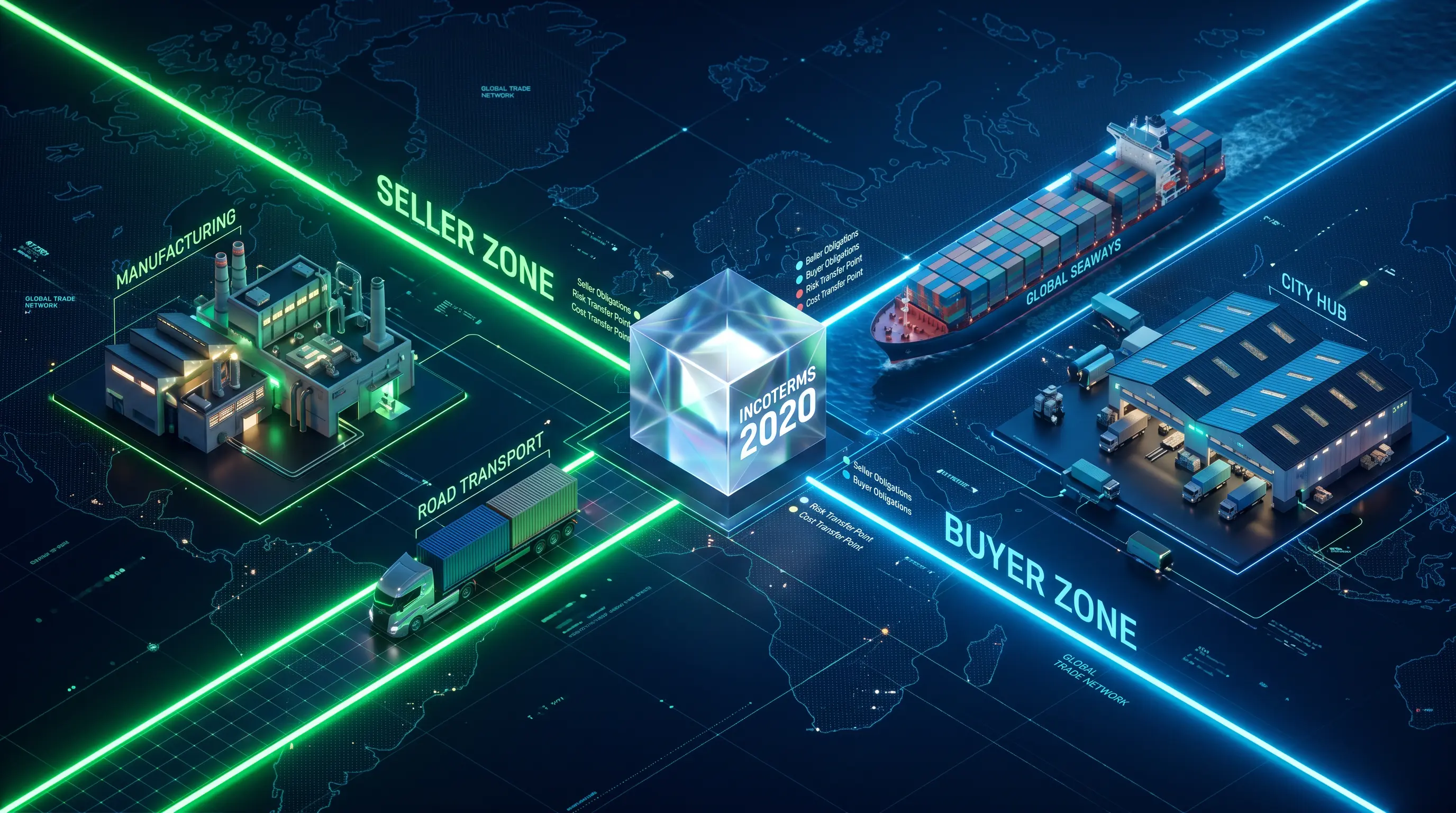
The fundamental purpose of Incoterms is to give a definitive answer to the question, “Where does responsibility begin, and where does it end?”
In the physical world, loading goods onto a truck is like transmitting an API request to the other party in the software world. In both scenarios, the boundaries must be drawn correctly for the transaction to be considered successful.
The most current Incoterms 2020 standards contain a total of 11 delivery terms. These are divided into two main categories according to the mode of transport.
2. Rules Covering All Modes of Transport
(Road, Air, Rail, etc.)
These rules are valid in all scenarios involving a single mode of transport or the sequential use of multiple modes (multimodal). The codes most frequently processed in logistics and ERP software are generally in this group.
| Code | Full Form (English – Turkish) | Risk, Cost, and Responsibility Details |
| EXW | Ex Works – Delivery at the Premises | The seller prepares the goods at its own facility (factory or warehouse). All subsequent customs clearance, transport costs, and risk, including loading, belong entirely to the buyer. |
| FCA | Free Carrier – Free to the Carrier | The seller delivers the goods to the carrier designated by the buyer, either at its own premises or at an agreed point. Export customs procedures are the seller’s responsibility. |
| CPT | Carriage Paid To – Carriage Paid | The seller pays for the transport up to the destination. However, the moment the goods are delivered to the first carrier, the risk passes to the buyer. |
| CIP | Carriage and Insurance Paid To – Carriage and Insurance Paid | It is an addition to the CPT rule. The seller is obliged to take out minimum-coverage insurance for the goods up to the destination. |
| DAP | Delivered at Place – Delivery at the Specified Point | When the goods reach the destination address, they are delivered ready to be unloaded from the vehicle. The buyer pays the import customs duties. |
| DPU | Delivered at Place Unloaded – Delivery Once Unloaded | The seller delivers the goods by unloading them from the vehicle at the destination. The risk of damage during unloading lies with the seller. |
| DDP | Delivered Duty Paid – Customs Duties Paid | It is the full-service model. Everything, including transport, insurance, and import customs duties, is the seller’s responsibility. The buyer only receives the goods. |
3. Rules Specific to Sea and Inland Waterways Only
These are rules used in container or bulk cargo operations, mainly concerning port-to-port sea transport.
| Code | Full Form (English – Turkish) | Risk, Cost, and Responsibility Details |
| FAS | Free Alongside Ship – Free Alongside the Ship | Delivery and the transfer of risk occur the moment the seller brings the goods alongside the designated ship (to the quay) at the port of loading. |
| FOB | Free on Board – Delivery Loaded onto the Ship | It is one of the most well-known terms. The risk passes to the buyer the moment the goods are loaded onto the ship (over the gunwale and onto the deck) at the port of loading. |
| CFR | Cost and Freight – Cost of Goods and Freight | The seller pays the ship freight (transport) required to reach the port of destination. The risk passes to the buyer the moment the goods are loaded onto the ship at the port of departure. |
| CIF | Cost, Insurance and Freight – Costs, Insurance, and Freight | It is the insured version of the CFR rule. The seller is obliged to take out marine transport insurance up to the port of destination. |
4. Managing Incoterms in Software and E-Commerce Systems
Incoterms is not just a logistics term; it is one of the most critical columns of the database tables in your software. Managing these codes correctly in an e-export system or ERP forms the backbone of the system architecture:
Cart (Checkout) and Tax Calculations: If you are selling to your customer on a B2C e-export site, whether your backend service calculates DDP or DAP is of vital importance. If you are selling DDP, your software must instantly and accurately pull the target country’s VAT and customs rates via API.
Customs and Shipping API Integrations: Missing or incorrect Incoterms information in the electronic bills of lading (AWB) sent to international carriers (DHL, FedEx, UPS) causes parcels to wait at customs for days.
Financial Reconciliation and ERP: Which cost is a “Shipping Expense” and which is an “Amount to Be Collected from the Buyer” is determined in the accounting software entirely based on this selected three-letter code.
5. Monitoring API Errors and Hidden Costs (Observability)
An outage in your microservices that communicate with customs services or logistics providers in cross-border trade results in major costs. For example, if your e-commerce site cannot connect to the API that calculates customs duty (DDP) for international orders due to a timeout, the duties may be miscalculated and your company will have to pay the bill.
For this reason, continuously monitoring the data flow behind your operational software and setting up a log management system that instantly detects API errors is just as important as tracking the physical cargo.
Conclusion: Anchor Your Operations to Universal Standards
Whether you are an operations manager running a warehouse or a software developer writing international shipping APIs, you must read Incoterms correctly and integrate them into your systems correctly.
Determining the delivery terms correctly prevents surprise costs, protects customer satisfaction, and keeps trade moving without slowing down. For a flawlessly functioning backend architecture and operational efficiency, never forget to keep your digital systems integrated with global standards at all times.